
LOAD MORE POSTS
How do funders help established organizations develop a network mindset?
Guest post by Adene Sacks As the GEO gathering comes to a close, funders are spending their morning on the practical consideration of how adopting a network mindset will change our day to day work. One of the most interesting discussions I participated in this morning focused on what networks mean for those established field organizations whose names are often synonymous with the work we do. Monitor Group senior consultant Heather Grant McLeod made the fascinating point that many of … [Read more...]
Networks and Social Movements
Guest post by Mary Manuel Movement: “A collection of persons or groups who come together around a common concern. Typically their mission is to bring about some type of societal change relative to their concern.” They are characterized by the following elements: collective intentional action, continuity of sustained action, outsider status, scope and scale, and formation of collective identity. * In her article Unstill Waters: The Fluid Role of Networks in Social Movements, Robin Katcher … [Read more...]
The Elephant in the Room: “Funders“ and Power
Guest post by Eugene Eric Kim (http://eekim.com/) Over the past two days at the GEO / Monitor Institute conference, "Growing social impact in a networked world,"(http://www.geofunders.org/networksconference.aspx) I've heard several people ask some variation of the same question over and over again: What is the role of the funder in all of this? This question has been bugging me, and I've been trying to figure out why. During Mary Manuel's session on movement and networks, it came to me. … [Read more...]
Wikimedia: Networks + Strategic Planning = Big Yes
Guest post by Carole Martin Sue Gardner of Wikimedia Foundation and Eugene Kim of Blue Oxen Associates paired up during Monday’s session to describe the approach they took during Wikimedia’s planning process. It quickly became obvious that by engaging a wide array of their volunteers in strategy formulation, they created an uncommon opportunity to educate community members about strategic thinking and inclusive processes in a networked world. Why does this matter? These skills are vital to … [Read more...]
What Mesh Businesses Should Support Philanthropy?
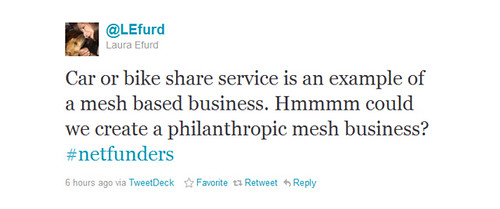
Guest Post by Stephen Downs The Mesh Laura Efurd sent this tweet during Lisa Gansky's discussion of the mesh concept at the GEO Growing Social Impact in a Networked World conference. Great, provocative question. Gansky's Mesh is based on the concept that unused value = waste and that information networks enable real-time brokering between customers and that unused capacity. So neighbors can share leaf lowers and snowblowers, companies can tap programmers for discrete jobs rather than … [Read more...]
The New Unit of Analysis: Networks
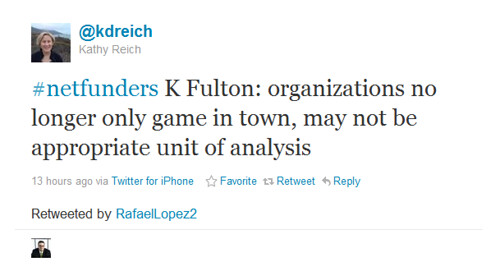
Guest post from Barbara Kibbe The organization is still relevant but no longer the only unit of analysis. The new reality of organizations as parts of networks requires another lens and different perspective Both organizations and networks can be means to ends. One reason to engage in networks is to enhance individual goals.They may or may not have programmatic goals. But it can't only be about process. Network participants ( be they individual or orgs) still have a purpose for their … [Read more...]
The Story of the Boston Youth Sports Initiative Network
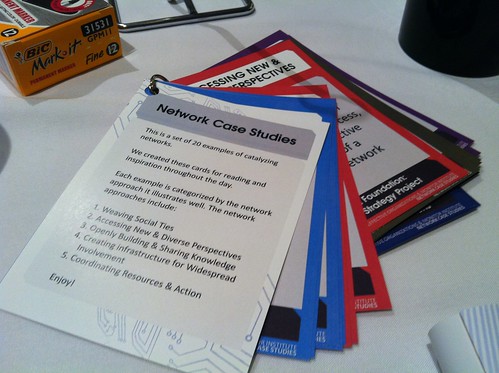
Note from Beth: Since the concept of working in Networks is can be hard to explain to newcomers, learning from case studies, stories, and examples can be illuminating. The design was to share this learning was amazing. In the morning, each of the ten case study presenters gave a 5 minute "teaser" about their case study or what one presenter called "showing a little leg." After lunch, conference participants got to to choose two presenters to spend an hour with in a small group to ask … [Read more...]
Ho'owaiwai: A Network in Hawaii
Note from Beth: Since the concept of working in Networks is can be hard to explain to newcomers, learning from case studies, stories, and examples can be illuminating. The design was to share this learning was amazing. In the morning, each of the ten case study presenters gave a 5 minute "teaser" about their case study or what one presenter called "showing a little leg." After lunch, conference participants got to to choose two presenters to spend an hour with in a small group to ask questions … [Read more...]
- « Previous Page
- 1
- …
- 108
- 109
- 110
- 111
- 112
- …
- 146
- Next Page »